Petr Žid: “If a request makes sense, we try to find a way to manufacture it.”
Surfactant manufacturing is built on well-established manufacturing procedures, operational experience and the ability to transfer laboratory results into real-world production. Our Production Director Petr Žid explains how the individual manufacturing processes work and how products are tested and scaled up. In the interview, he also explains how we approach specific customer requirements.
When people hear the title Production Director, many picture someone sitting behind a desk. What is your job actually like?
For me, that’s not so far off the mark. A large part of my work is done in the office – dealing with authorities, working with technology suppliers and attending various meetings. Of course, I try not to lose touch with our production operations (and especially the people working there), so I spend part of my time on the shop floor as well. Otherwise, this side of things is primarily the responsibility of our middle management colleagues, the production supervisors who deal with everyday operational matters. However, I’m always available whenever more complex issues arise.
I’m actively involved in the modernisation and automation of individual processes, from manufacturing itself through to documentation and the gradual transition to digital records. This makes our colleagues’ work much easier while improving accuracy and speeding up processes. There’s always something to be improved and developed. It’s a very creative job, and the results tend to show relatively quickly. That’s what I enjoy most about working at ENASPOL.
How would you explain a sulfonation line to someone who knows nothing about chemical manufacturing?
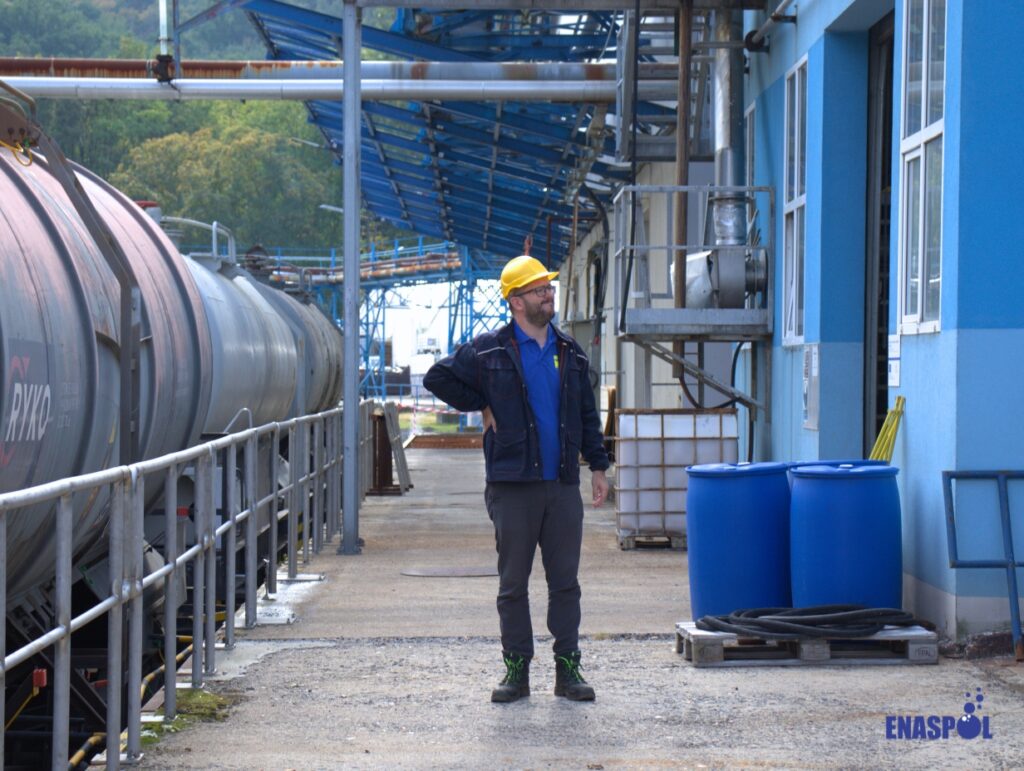
During interviews, I always say that our production can be divided into three main areas: discontinuous (or batch) production, continuous production, and drying plants. Sulfonation takes place in both batch and continuous production. Batch production can be compared to cooking – you have a big pot, to which you gradually add all the raw materials, and if you follow the recipe, a few hours later you’ve got some good goulash. In our case, of course, the result is sulfonic acid. We then process that further through subsequent production stages until we obtain the finished product. To give you an idea, the entire process takes around 25 to 30 hours.
A continuous process, on the other hand, is one in which raw materials are continuously fed into the reactor, and finished products emerge at the other end. You can think of the reactor as two pipes of different diameters, with one inserted inside the other. A thin film of the raw material flows down the walls, while a gas containing the second raw material, sulfur trioxide, flows through the space between them. That’s a simplified description of the process.
In your experience, what is the most important factor in surfactant manufacturing? How do you ensure that raw materials behave in production in the same way they do on paper or in the laboratory?
As with any manufacturing process, it’s essential to follow established procedures. I wouldn’t say that surfactant production is fundamentally different from other chemical manufacturing operations. We know from experience that if something works in the laboratory, we can usually transfer it successfully to real production. As far as batch production is concerned, this is exactly the approach we follow. We start with laboratory-scale preparation, and it’s only after that has been completed that we move on to pilot-scale and full-scale production trials.
In the case of continuous production, however, we test the product directly in the full-size reactor, without an intermediate laboratory stage. Products manufactured by continuous sulfonation are generally quite similar, enabling us to predict their behaviour reasonably well. Basically, the product is always a sulfonic acid, which we then neutralise and dilute to the required concentration in most cases. In batch production, on the other hand, we manufacture a wide range of chemically diverse products: from sulfonates and amine oxides to alkanolamides, betaines, sulfosuccinates and simpler surfactant blends.
When a customer needs a formulation to be modified or a new sample to be tested quickly, what does that process involve in practice?
Modifications like that usually need to be tested on a laboratory scale first, and once they have been successfully validated in the laboratory, a sample can be sent to the customer for testing. However, we can also move directly to full-scale production and manufacture the quantity the customer needs. Naturally, this also depends on the production schedule and available capacity. After all, it’s not always possible to manufacture the required substance immediately, and it is then up to us to find space for it within our production capacity.
In your opinion, what is the biggest difference between ENASPOL and a large multinational supplier?
Flexibility and a willingness to find tailor-made solutions for individual customers. For example, one customer recently asked us to include chlorides in one of our standard products, even though chlorides are not normally present in products manufactured using our type of sulfonation. We first tested the effect of adding chlorides in the laboratory and then found a way to make it work in continuous production, all within a matter of weeks. There are several such examples. We try to look beyond our product portfolio, and if a customer’s requirement is feasible and makes sense to us, we always try to do everything we can.
How small or how specialised a batch are you able to produce? Do you see flexibility as important for customers?
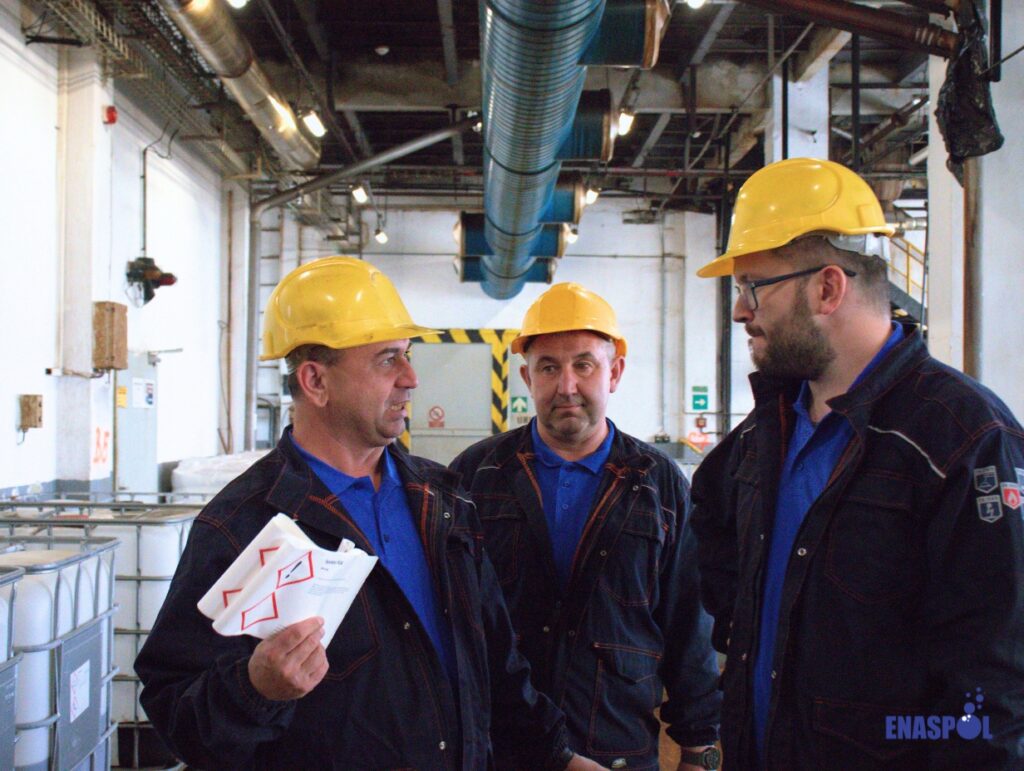
The smallest batches we are able to manufacture are around 200-300 kg. That’s also roughly the standard size of a pilot-scale operation when transferring a process from research to production. As for flexibility, I definitely see it as something that matters to our customers.
Where do you feel the greatest pressure in manufacturing – cost, speed, regulatory requirements or sustainability? How can all of that be combined with quality?
I’d say the greatest pressure is on speed. Automating production has enabled us to increase capacity with the same number of people and, to a large extent, the same production equipment, without affecting the product’s quality parameters. At the same time, we are fully aware that this approach has its limits. That’s why we currently have a number of projects under way in various production areas aimed at further increasing capacity and building new production lines, both for existing products and for products currently under development. Expanding the energy and utility capacity required for our manufacturing processes is also an integral part of this.
Our interview with Petr Žid shows that chemical manufacturing is not a closed process that is set up once and then simply repeated. Alongside day-to-day operations, technologies need to be continuously developed, capacities expanded and new ways found to adapt to market requirements. From the very beginning, ENASPOL has built on its decades of surfactant manufacturing, technical know-how and the ability to respond to specific customer requirements.