Comparison of dermal irritation and foaming properties of SLES and SLS in professional cosmetic formulations
Sodium Laureth Sulfate (SLES) and Sodium Lauryl Sulfate (SLS) belong to the group of anionic surfactants — surface-active agents widely used in modern cosmetics and cleaning products for their ability to effectively remove impurities and generate foam. In practice, the choice between SLES and SLS is determined not only by their physico-chemical properties, but also by regulatory requirements, formulation objectives and end-user expectations.
Comparison of chemical structure and its impact on the skin
SLS is a simple sulphated molecule with a lower molecular weight and higher lipophilicity, which allows it to penetrate the skin’s lipid barrier more rapidly. SLES, by contrast, is an ethoxylated form of SLS. It contains ethoxy (–O–CH₂–CH₂–) groups that increase molecular weight and reduce the ability to dissolve lipids within the skin. This difference in chemical structure has a direct impact on skin tolerance. Due to its larger molecular size, SLES penetrates the skin barrier to a lesser extent, which is a key factor in the product’s mildness.
While many of our competitors stop at a general description of these differences, ENASPOL’s technologists work with specific parameters such as CMC (Critical Micelle Concentration) when developing and recommending formulations. We analyse how molecular structure and the degree of ethoxylation influence surfactant behaviour in the final formulation, allowing us to recommend solutions that achieve an optimal balance between performance and skin compatibility.
How ethoxylation modifies surfactant behaviour
Ethoxylation is a chemical modification in which ethylene oxide units are added to the SLS molecule. This increases the hydrophilic portion of the molecule and reduces its affinity for the lipid bilayer of the skin. For formulators, this process is valued not only for reducing irritation, but also for adjusting foaming behaviour and improving compatibility with other formulation components.
At the same time, ethoxylation can generate the unwanted by-product 1,4-dioxane, which is strictly regulated under European legislation (e.g. Regulation (EC) No. 1223/2009). A properly controlled production process includes effective stripping distillation and analytical monitoring to ensure that dioxane levels remain well below regulatory limits — see the article Guide to 1,4-Dioxane.
Practical experience with dermal irritation
In practice, irritation potential is assessed using tests such as patch testing or transepidermal water loss (TEWL) measurements. SLS typically shows higher levels of erythema (redness) and oedema (swelling), whereas SLES, thanks to ethoxylation, demonstrates improved skin compatibility and significantly reduces these adverse effects. Although irritation caused by both substances is generally reversible, the impact of SLES on skin barrier stability is considerably milder. This is why SLES is the preferred surfactant in products intended for daily use, such as baby shampoos or mild cleansing emulsions. A detailed comparison of dermal reactions is provided in the table below.
From a formulation perspective, SLES is often combined with non-ionic components (e.g. alkyl polyglucosides), further reducing irritation potential while maintaining functional performance.
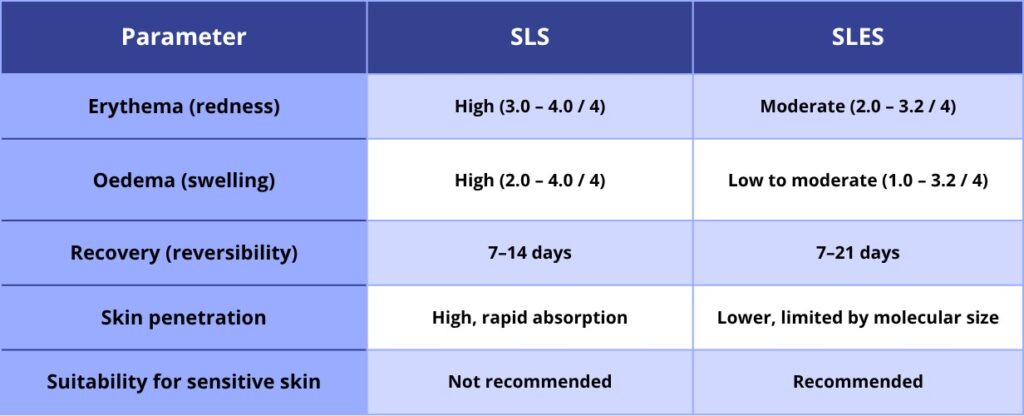
Note: Evaluation is based on a standardised scale from 0 (no reaction) to 4 (maximum irritation).
Differences in foaming behaviour and sensory perception
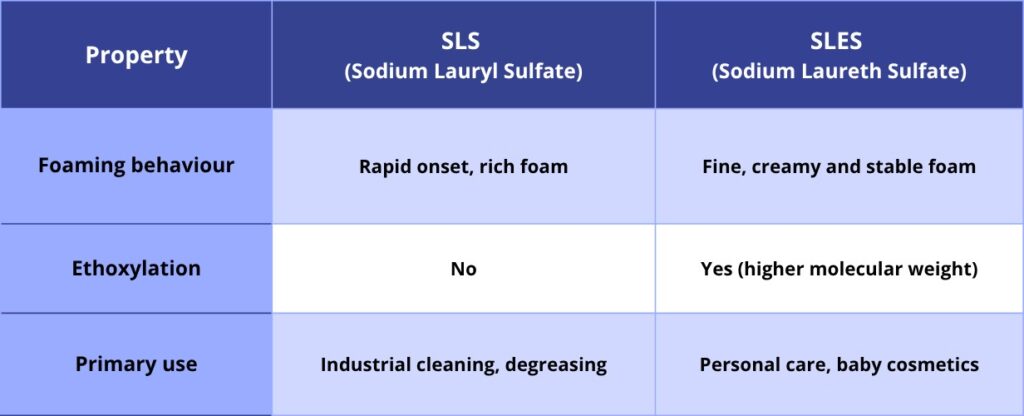
Foaming plays a key role in how end users perceive product quality. SLS provides a rapid onset of rich foam, but with lower mechanical stability of the bubbles, which can lead to a faster collapse. SLES produces a finer, creamier foam that is more stable over time, which is particularly desirable in premium personal care products such as shower gels. For formulators, the choice between SLES and SLS is therefore also a matter of the target sensory profile and the product’s market positioning.
Modern low-irritation alternatives
In addition to traditional sulphates, modern formulations increasingly incorporate surfactants with even lower irritation potential. A key group includes alpha-olefin sulfonates (AOS). These are valued both globally and within ENASPOL’s portfolio for their excellent foaming performance and demonstrably higher dermal mildness compared to standard SLES/SLS systems.
Another important alternative widely used in both domestic and international formulations is ALES (Ammonium Laureth Sulfate). From a dermal safety perspective, ALES is generally considered even milder than SLES, primarily due to its specific molecular structure. Its larger molecular size further limits penetration into deeper layers of the skin, reducing the risk of irritation. Formulators value ALES not only for its mildness, but also for its specific foaming profile and excellent compatibility with other formulation components, enabling the development of stable and sensorially attractive products.
The market is also complemented by other mild ingredients such as alkyl polyglucosides (APG) and emerging biosurfactants, which offer favourable environmental profiles and high biodegradability.
The choice for modern formulations
The choice between SLS, SLES and milder alternatives such as AOS and ALES is not just a matter of cost, but primarily a reflection of your brand’s strategy in dermal safety. While SLS remains a powerful solution for specific industrial applications, SLES and its advanced variants offer a safer pathway for modern cosmetic formulations without compromising foaming performance. At ENASPOL, we help you find the right balance, supporting the development of products that combine performance, skin compatibility and user comfort.
Frequently asked questions
What is the difference in the chemical structure between SLS and SLES?
SLS has a simple sulphated chain, while SLES contains ethoxy groups that modify how the molecule interacts with lipids.
Why is SLES generally milder?
Its larger molecular size and lower lipophilicity result in reduced skin penetration and therefore lower irritation.
Can SLS damage the skin barrier?
Yes, particularly with frequent use in concentrated formulations without suitable conditioning components.
What is 1,4-dioxane and why is it monitored?
1,4-dioxane is a by-product of ethoxylation with potential health risks. It is therefore strictly regulated and carefully monitored.
What are the current natural alternatives?
For example, alkyl polyglucosides and biosurfactants, often used in combination with other surfactants for optimal performance. Among synthetic options, alpha-olefin sulfonates are also widely used.